In Labs 4 and 5 you found optimal flood defenses for a city. Today we switch scales: a homeowner in Norfolk, VA must decide how high to elevate their house above the floodplain.
The key uncertainty is sea-level rise (SLR), which depends on the global emissions pathway. Two futures are possible:
Aggressive mitigation (RCP 2.6) — the world cuts emissions sharply, SLR stays modest.
Business as usual (RCP 8.5) — emissions continue growing, SLR accelerates.
The homeowner doesn’t know which pathway the world will follow, but must decide on an elevation height now (construction happens once). Today you’ll compute the Expected Value of Perfect Information (EVPI) and the Expected Value of Imperfect Information (EVII) to determine how much it’s worth to learn about future emissions before committing.
We use a HAZUS depth-damage function for a single-story house with no basement, typical of Norfolk’s coastal housing stock. The house sits at 8 ft above the local tide gauge.
House construction (click to expand)
haz_fl_dept = CSV.read("data/haz_fl_dept.csv", DataFrame)# Single-story, no basement, A-Zone (FIA DmgFnId 105)ddf_row =filter(r -> r.DmgFnId ==105, haz_fl_dept)[1, :]house =House( ddf_row; value_usd=250_000, # house value area_ft2=1_500, # floor area height_above_gauge_ft=8.0, # first-floor elevation above tide gauge)
3.3 Sea-Level Rise from BRICK
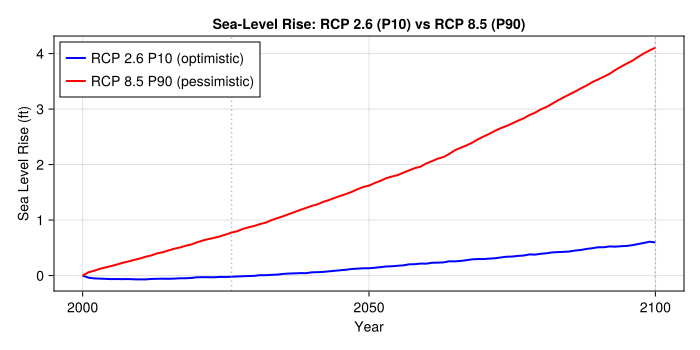
We load BRICK sea-level rise projections (Ruckert et al., 2019) for Sewells Point, Norfolk, VA. The BRICK ensemble contains thousands of SLR trajectories under each RCP scenario.
The two states of the world correspond to the emissions pathway the world follows:
RCP 2.6 — aggressive mitigation (10th percentile of BRICK ensemble)
RCP 8.5 — business as usual (90th percentile of BRICK ensemble)
We use tail percentiles (not ensemble means) to sharpen the contrast: RCP 2.6 with a low climate response, vs RCP 8.5 with a high climate response.
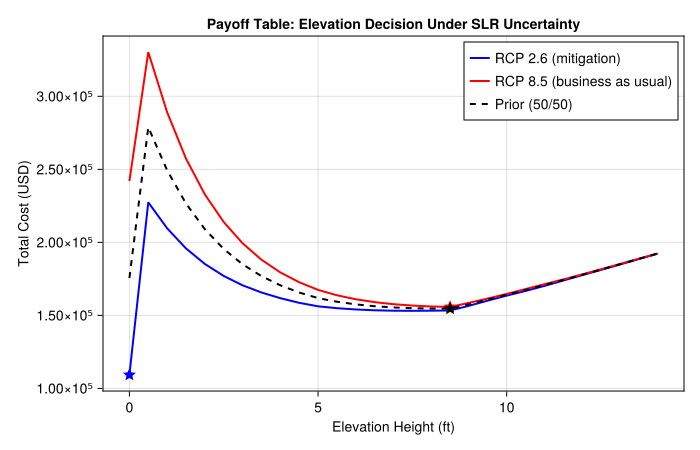
We sweep a grid of elevation heights and compute total cost (construction + NPV of expected flood damages) under each SLR future.
height_grid =0.0:0.5:14.0costs_low = [compute_total_cost(config, scenario_low, h) for h in height_grid]costs_high = [compute_total_cost(config, scenario_high, h) for h in height_grid]costs_prior = p_high .* costs_high .+ p_low .* costs_low
Figure 2: Total cost (construction + NPV of expected damages) vs. elevation height under each emissions pathway. Blue: RCP 2.6. Red: RCP 8.5. Dashed black: prior-weighted average (50/50). Stars mark the optimum for each curve.
How do the optimal elevation heights differ between the two SLR futures? Why does this make intuitive sense?
Why are the cost curves U-shaped? What happens at very low vs. very high elevation?
5 Computing EVPI
Use the payoff table to compute the Expected Value of Perfect Information. Since we’re minimizing cost (not maximizing utility), the formula uses \(\min\) instead of \(\max\):
Interpret the EVPI in dollars. How much would this homeowner pay for a perfect forecast of the future emissions pathway?
What fraction of the house value ($250,000) does the EVPI represent?
Is this EVPI large enough to justify funding climate policy research? What other homeowners might benefit from the same information?
6 Computing EVII
Suppose an international Climate Policy Progress Report rates the likelihood of meeting Paris Agreement goals as either “on track” or “off track.” The report isn’t perfectly accurate: it tends to say “on track” when emissions are following RCP 2.6, and “off track” when following RCP 8.5, but it sometimes gets it wrong.
Use Bayes’ rule to compute the posterior probability of RCP 8.5 given each report signal.
# Your code here
6.3 Exercise: EVII
Re-weight the payoff table using the posterior probabilities and compute EVII. No new simulations needed — just re-weight the same cost arrays with updated beliefs.
where \(z\) is the report signal and \(p(s|z)\) is the posterior from Bayes’ rule.
# Your code here
Table 2: Summary of information value: no information, policy report, and perfect information
# Your code here
# Your code here
Figure 3
TipYour Response — Question 3
What fraction of the EVPI does the policy report capture? Why is EVII < EVPI? What would make the report more valuable?
TipYour Response — Question 4
The homeowner is considering two research investments:
Fund a climate policy analysis that would perfectly predict the future emissions pathway.
Fund a tide gauge network that would reduce storm surge uncertainty.
Based on your EVPI result, what is the maximum value of investment (1)? Why might investment (2) have a different (possibly larger or smaller) ceiling?
Extensions (Optional)
If you finish early, try one of these:
Change the prior: What happens to EVPI if RCP 8.5 is 80% likely instead of 50/50? At what prior does EVPI become negligible?
Change signal accuracy: What if the policy report is only 60% accurate? 99% accurate? Plot EVII vs. accuracy.
More RCP scenarios: Add RCP 4.5 and RCP 6.0 as additional states. How does EVPI change with more emissions pathways?
7 Summary
Key takeaways from this lab:
EVPI is the gap between “optimize then average” and “average then optimize” — the maximum value of any information source about a given uncertainty.
EVII extends EVPI to imperfect signals via Bayes’ rule — re-weight the same payoff table with posterior beliefs, no new simulations needed.
Information is only valuable when it changes the optimal decision. If the optimal action is the same regardless of the state, EVPI is zero.
The EVPI for one uncertainty bounds the value of any research into that uncertainty — use it to prioritize research investments.
8 Submission
Write your answers in the response boxes above.
Render to PDF:
In VS Code: Open the command palette (Cmd+Shift+P / Ctrl+Shift+P) → “Quarto: Render Document” → select Typst PDF
Or from the terminal: quarto render index.qmd --to typst
Ruckert, K. L., Srikrishnan, V., & Keller, K. (2019). Characterizing the deep uncertainties surrounding coastal flood hazard projections: A case study for Norfolk, VA. Scientific Reports, 9(1), 1–12. https://doi.org/10.1038/s41598-019-47587-6
Zarekarizi, M., Srikrishnan, V., & Keller, K. (2020). Neglecting uncertainties biases house-elevation decisions to manage riverine flood risks. Nature Communications, 11(1, 1), 5361. https://doi.org/10.1038/s41467-020-19188-9