Probabilistic Risk and Tail Risks

Lecture

Dr. James Doss-Gollin

Monday, February 2, 2026

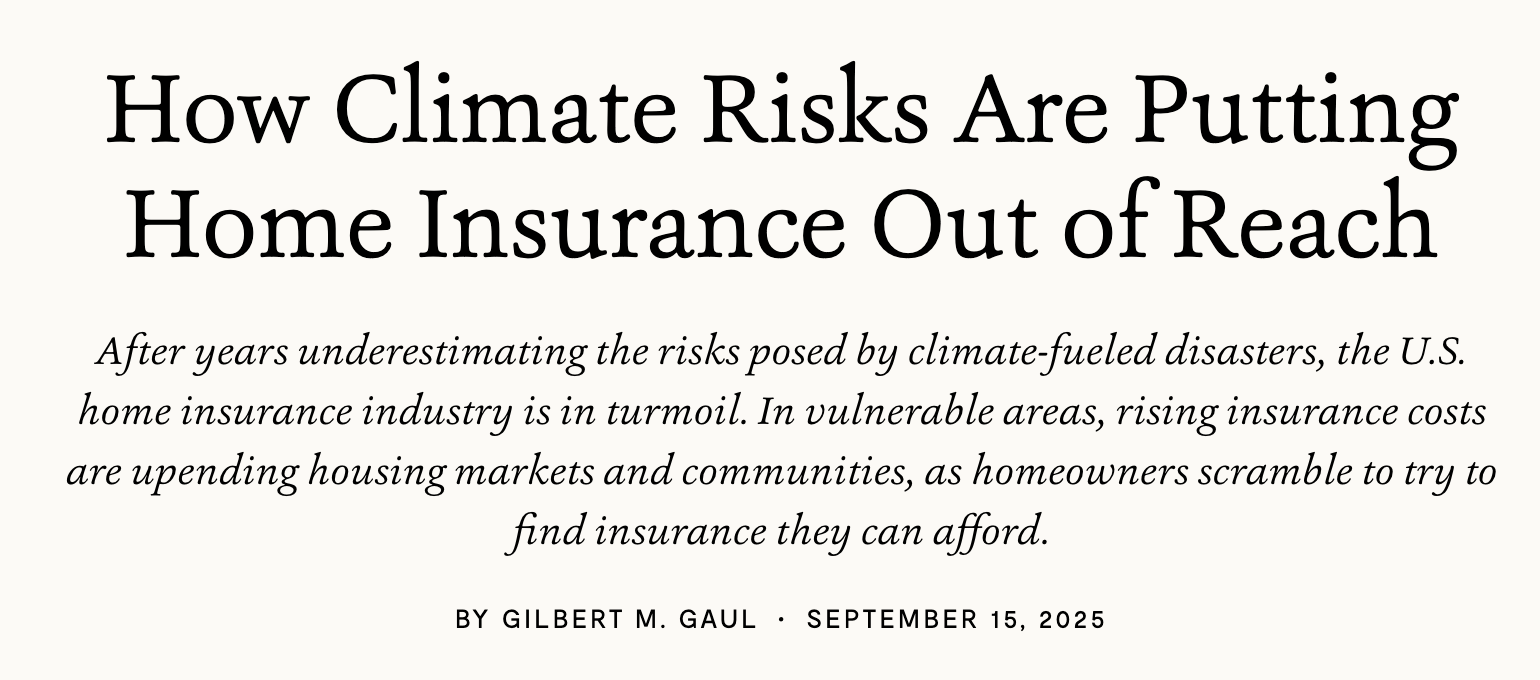
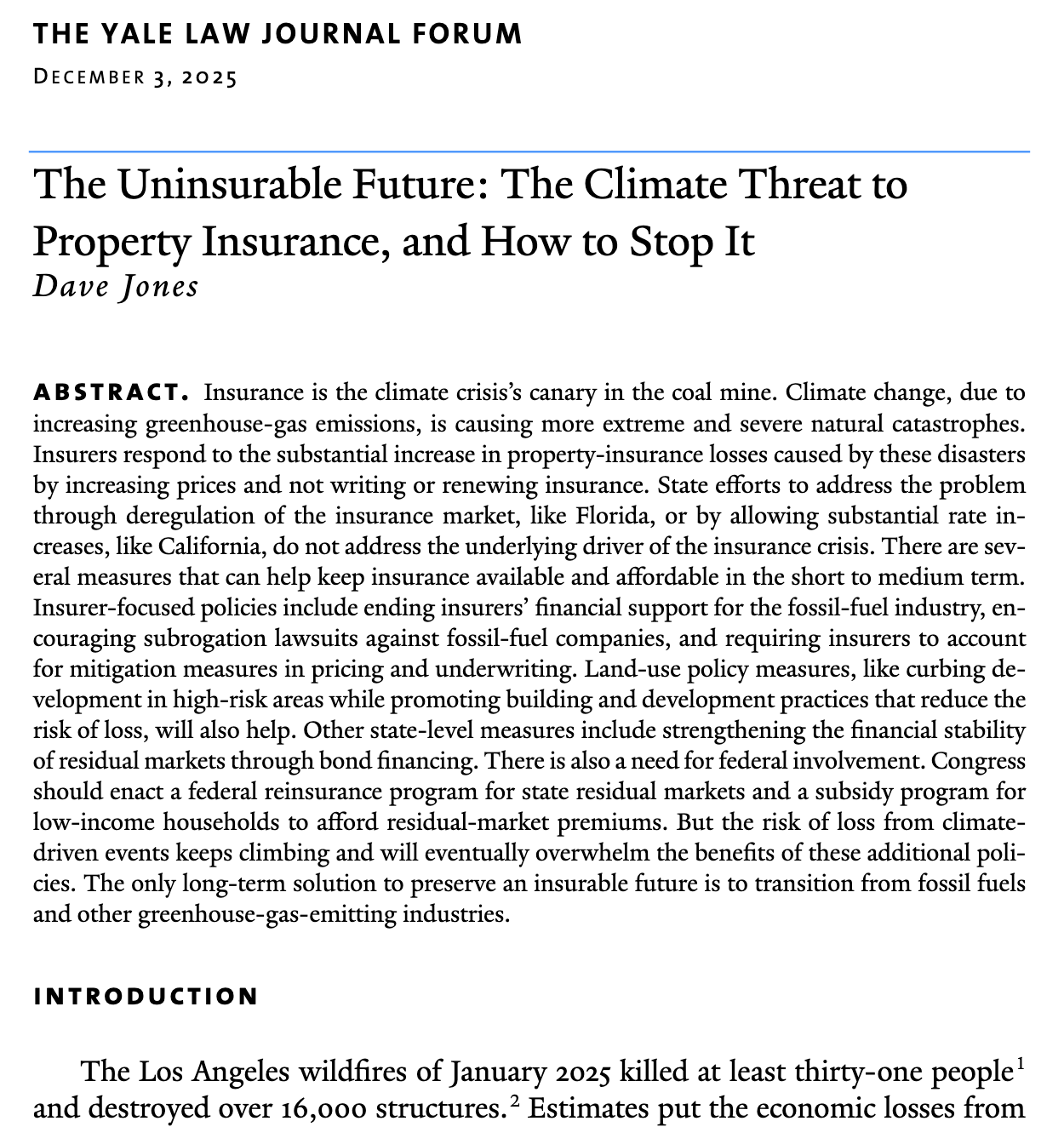
From Climate Risk to Insurance Premiums

Jones (2025)

The common thread: When the “worst case” keeps happening, models break down.

Today: The vocabulary and tools to talk about these tail risks.

Building on Week 2

\[ \begin{aligned} E[D] &= \int D(h) \cdot p(h) \, dh \\ & \approx \frac{1}{N} \sum_{i=1}^{N} D(h_i) & \textrm{if } h_i \sim p(h) \end{aligned} \]

The problem: With fat tails, this expectation is hard to estimate.

  • Rare extreme events dominate the sum
  • Different assumptions about tail shape → very different \(E[D]\)

Today’s Roadmap

  1. Vocabulary: Return periods and return levels
  2. Fat tails: When extremes dominate
  3. Risk metrics: EAD, VaR, CVaR
  4. Monte Carlo: Computing any metric from samples

Vocabulary: Extreme Value Statistics

Today

  1. Vocabulary: Extreme Value Statistics

  2. Fat Tails

  3. Risk Metrics

  4. Monte Carlo for Risk Metrics

  5. Wrap Up

Two Ways to Ask the Same Question

Return Period (\(T\))

“How often does a flood this big happen?”

  • Average time between exceedances
  • \(T = 1/p\) where \(p\) is annual exceedance probability

Return Level (\(x_T\))

“How big is a T-year flood?”

  • The intensity exceeded once every \(T\) years on average
  • \(x_T = F^{-1}(1 - 1/T)\)

These are inverse operations on the CDF.

“100-Year Floods” and Your Mortgage

Over 30 years: \(1 - (0.99)^{30} = 26\%\) chance of at least one

  • Houston experienced three “500-year” floods in three years (Harvey, Tax Day, Memorial Day)
  • What are possible explanations?

Return Level Calculation

For a GEV distribution with parameters \((\mu, \sigma, \xi)\):

\[x_T = \mu + \frac{\sigma}{\xi}\left[\left(-\ln\left(1 - \frac{1}{T}\right)\right)^{-\xi} - 1\right]\]

In Julia, this is just:

quantile(gev_dist, 1 - 1/T)

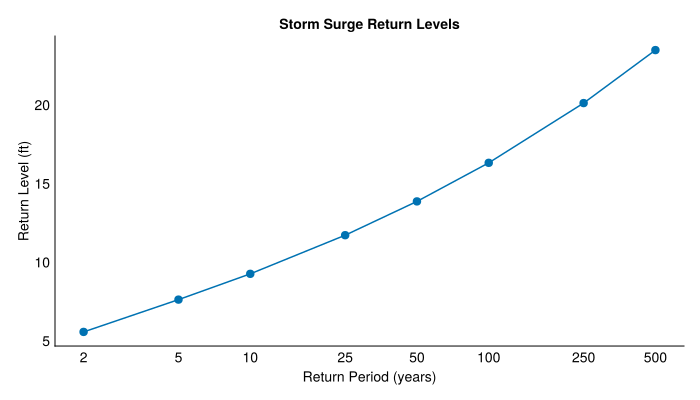
Return Levels in Practice

Code
# Define a GEV for storm surge (typical Gulf Coast parameters)
gev = GeneralizedExtremeValue(5.0, 1.5, 0.2)  # μ=5ft, σ=1.5ft, ξ=0.2

# Calculate return levels
return_periods = [2, 5, 10, 25, 50, 100, 250, 500]
return_levels = [quantile(gev, 1 - 1 / T) for T in return_periods]

# Plot
fig = Figure(size=(700, 400))
ax = Axis(fig[1, 1],
    xlabel="Return Period (years)",
    ylabel="Return Level (ft)",
    xscale=log10,
    title="Storm Surge Return Levels")
scatterlines!(ax, return_periods, return_levels, markersize=12)
ax.xticks = return_periods
fig

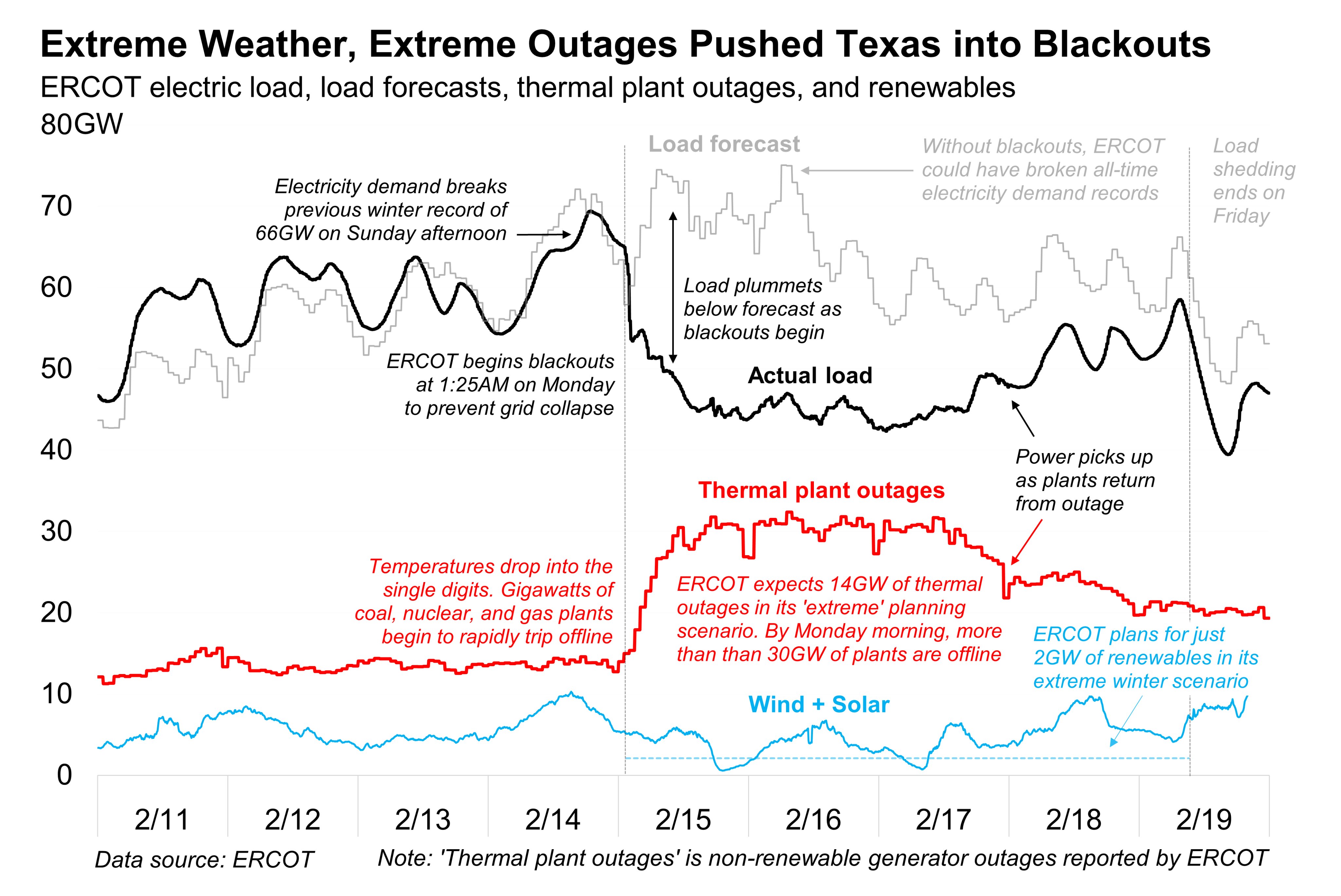
2021 Texas Freeze

Figure 1: Electricity demand (blue) exceeded supply (red) for multiple consecutive days. Source: Bryan Bartholomew on Twitter

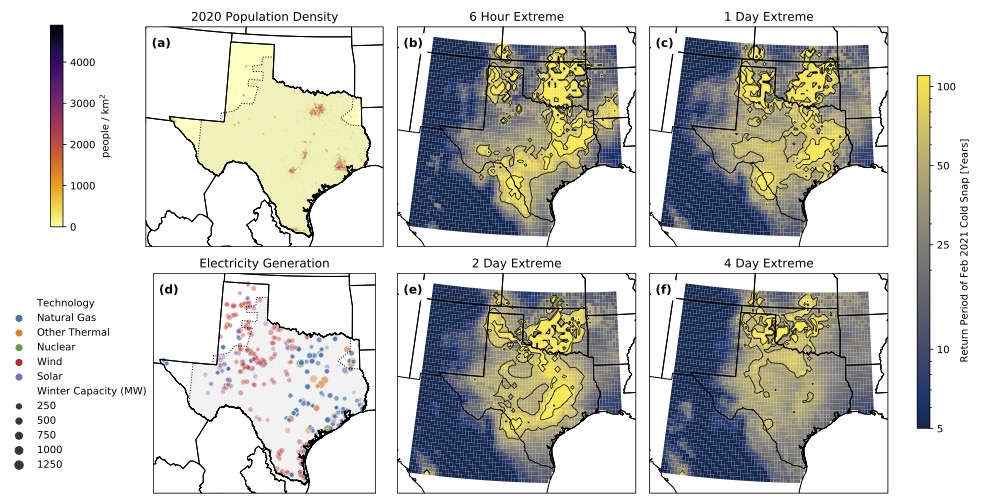
How extreme was the cold?

Figure 2: Return period of heating demand as across space (Doss-Gollin et al., 2021).

Return Period vs. Duration

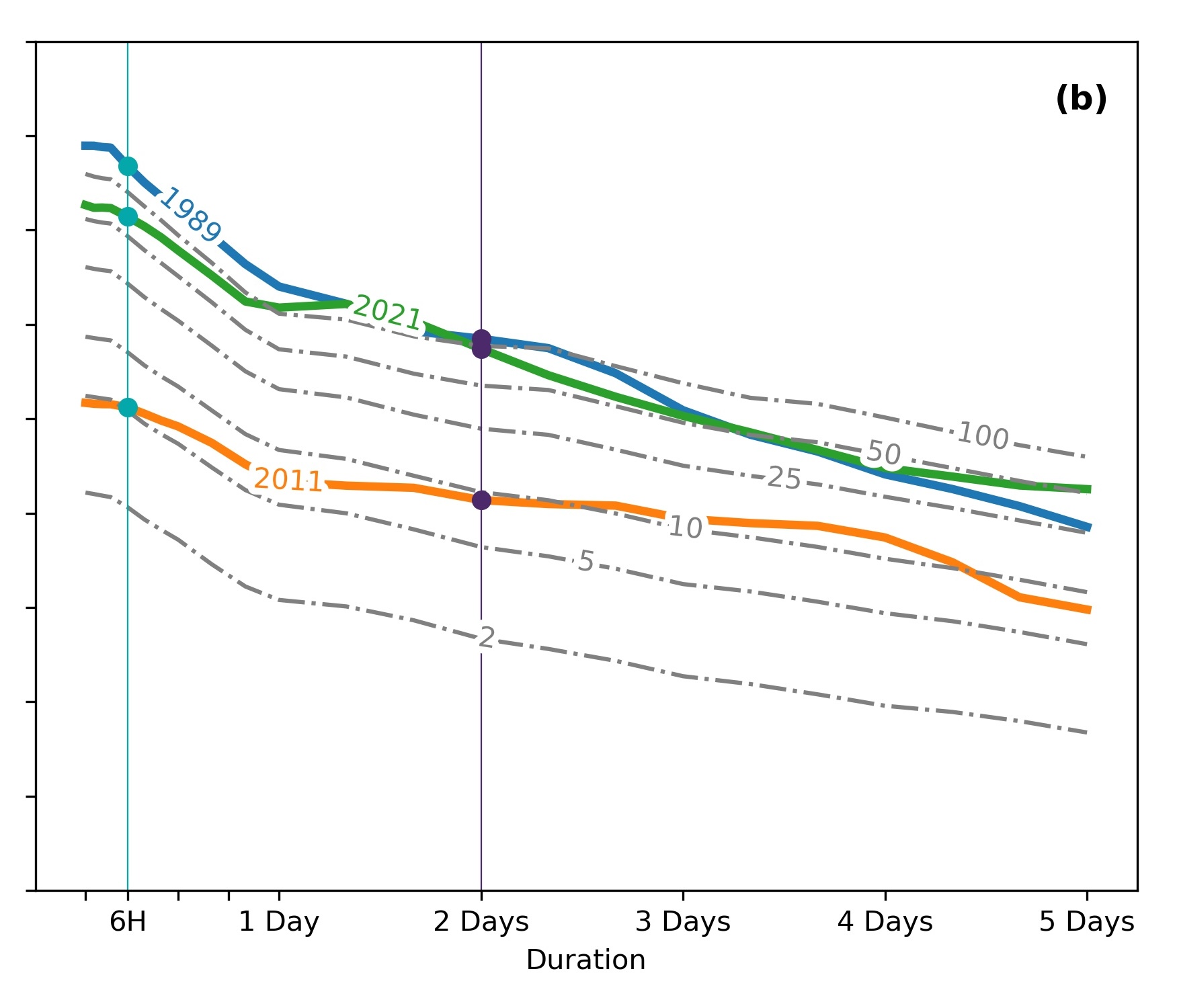
Figure 3: Return period of heating demand during Feb 2021 as a function of event duration (Doss-Gollin et al., 2021).

Intensity Measures Matter

Key insight: Return period depends on how you define the event.

ERCOT Example Return Period Impact
1-day cold snap ~10 years Grid can handle
5-day cold snap ~50 years Cascading failures

General principle: The choice of intensity measure affects everything downstream.

Hazard Intensity Measures
Cold snaps Peak temperature, duration, spatial extent
Floods Depth, duration, extent, velocity
Heat waves Peak temperature, duration, humidity

There are statistical approaches to specifying return periods for multivariate or compound extremes, such as copulas.

Fat Tails

Today

  1. Vocabulary: Extreme Value Statistics

  2. Fat Tails

  3. Risk Metrics

  4. Monte Carlo for Risk Metrics

  5. Wrap Up

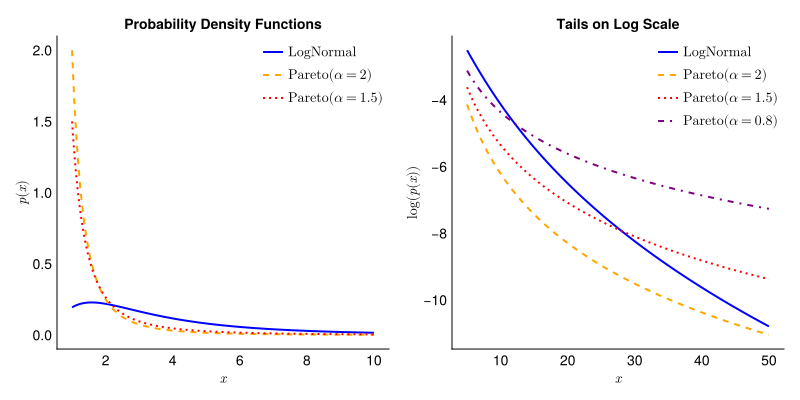
Normal vs. Fat-Tailed

Code
let
    fig = Figure(size=(800, 400))

    # Define distributions with different tail behavior
    # Match location/scale to make comparison "fair"
    xmin = 1.0

    # Pareto distributions with different tail indices (alpha)
    # α ≥ 2: finite mean and variance (physically plausible)
    # α ∈ [1, 2): finite mean, infinite variance (some extreme events)
    # α < 1: infinite mean and variance (very extreme, unlikely in nature)
    pareto_α2 = Pareto(2.0, xmin)  # α = 2: physically plausible
    pareto_α15 = Pareto(1.5, xmin)  # α = 1.5: very heavy tail
    pareto_α08 = Pareto(0.8, xmin)  # α = 0.8: infinite mean/variance

    # LogNormal for comparison (light-tailed relative to Pareto)
    lognormal = LogNormal(log(3), 0.8)

    # Left panel: PDFs
    ax1 = Axis(fig[1, 1], xlabel=L"x", ylabel=L"p(x)",
        title="Probability Density Functions")
    x = range(xmin, 10, length=1_000)
    lines!(ax1, x, pdf.(lognormal, x), label=L"$\text{LogNormal}$", linewidth=2, color=:blue)
    lines!(ax1, x, pdf.(pareto_α2, x), label=L"Pareto($\alpha=2$)",
        linewidth=2, linestyle=:dash, color=:orange)
    lines!(ax1, x, pdf.(pareto_α15, x), label=L"Pareto($\alpha=1.5$)",
        linewidth=2, linestyle=:dot, color=:red)
    axislegend(ax1, position=:rt)

    # Right panel: Log-scale to see tails
    ax2 = Axis(fig[1, 2], xlabel=L"x", ylabel=L"\log(p(x))",
        title="Tails on Log Scale")
    x2 = range(5, 50, length=500)
    lines!(ax2, x2, logpdf.(lognormal, x2), label=L"$\text{LogNormal}$",
        linewidth=2, color=:blue)
    lines!(ax2, x2, logpdf.(pareto_α2, x2), label=L"Pareto($\alpha=2$)",
        linewidth=2, linestyle=:dash, color=:orange)
    lines!(ax2, x2, logpdf.(pareto_α15, x2), label=L"Pareto($\alpha=1.5$)",
        linewidth=2, linestyle=:dot, color=:red)
    lines!(ax2, x2, logpdf.(pareto_α08, x2), label=L"Pareto($\alpha=0.8$)",
        linewidth=2, linestyle=:dashdot, color=:purple)
    axislegend(ax2, position=:rt)

    fig
end

The Pareto Tail Index

For a Pareto distribution: \(P(X > x) \sim x^{-\alpha}\) as \(x \to \infty\)

Tail index \(\alpha\) controls both tail heaviness and moment existence:

\(\alpha\) Mean Variance Physical Plausibility
\(\alpha \geq 2\) Finite Finite Most climate/flood risks
\(1 < \alpha < 2\) Finite Infinite Some extreme events
\(\alpha < 1\) Infinite Infinite Unlikely in nature

Estimating the Tail Index

Hill estimator for tail index from the \(k\) largest observations:

\[\hat{\alpha} = \left[\frac{1}{k}\sum_{i=1}^k \ln\frac{X_{(i)}}{X_{(k+1)}}\right]^{-1}\]

Pitfalls:

  • Requires choosing threshold \(k\) (how many extremes to use?)
  • Need many observations in the tail to estimate reliably
  • Historical data often too short for rare extremes

Why Do Fat Tails Matter?

For fat-tailed distributions:

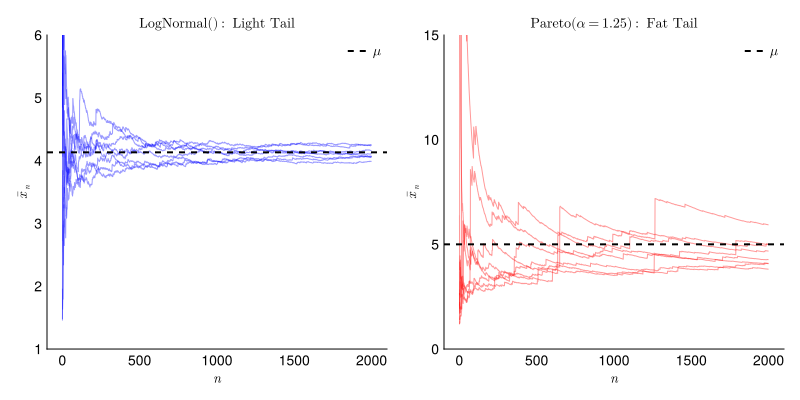
  • The mean can be dominated by rare extreme events
  • Sample averages converge slowly to the true mean
  • Historical data undersamples the tail

“The average is dominated by a small number of extreme values.”

Slow Convergence of the Mean

Code
let
    function running_mean(samples)
        n = length(samples)
        cumsum(samples) ./ (1:n)
    end

    n_samples = 2000
    n_lines = 8

    fig = Figure(size=(800, 400))

    # LogNormal distribution (light tail)
    ax1 = Axis(fig[1, 1], xlabel=L"n", ylabel=L"\bar{x}_n",
        title=L"LogNormal$()$: Light Tail")
    lognormal = LogNormal(log(3), 0.8)
    for _ in 1:n_lines
        samples = rand(lognormal, n_samples)
        lines!(ax1, 1:n_samples, running_mean(samples), color=(:blue, 0.4), linewidth=1)
    end
    hlines!(ax1, [mean(lognormal)], color=:black, linestyle=:dash, linewidth=2,
        label=L"\mu")
    axislegend(ax1, position=:rt)
    ylims!(ax1, 1, 6)

    # Pareto distribution (α = 1.5, fat-tailed)
    ax2 = Axis(fig[1, 2], xlabel=L"n", ylabel=L"\bar{x}_n",
        title=L"Pareto($\alpha=1.25$): Fat Tail")
    pareto_fat = Pareto(1.25, 1.0)
    for _ in 1:n_lines
        samples = rand(pareto_fat, n_samples)
        lines!(ax2, 1:n_samples, running_mean(samples), color=(:red, 0.4), linewidth=1)
    end
    hlines!(ax2, [mean(pareto_fat)], color=:black, linestyle=:dash, linewidth=2,
        label=L"\mu")
    axislegend(ax2, position=:rt)
    ylims!(ax2, 0, 15)

    fig
end

Implications for Risk Assessment

For fat-tailed hazards:

  • Usually, the average over N years is less than the true mean
  • The mean is dominated by rare extremes you probably haven’t observed yet
  • Occasionally you get unlucky and observe a tail event—then your estimate jumps

Implication: Historical averages systematically underestimate risk.

We need metrics that focus specifically on the tail.

Risk Metrics

Today

  1. Vocabulary: Extreme Value Statistics

  2. Fat Tails

  3. Risk Metrics

  4. Monte Carlo for Risk Metrics

  5. Wrap Up

From Expected Value to Tail Focus

Expected Annual Damage (EAD) averages over everything:

\[\text{EAD} = E[D] = \int D(h) \cdot p(h) \, dh\]

But decision-makers often care more about worst-case scenarios:

  • “What’s the damage I should prepare for?”
  • “What’s the catastrophic loss I might face?”

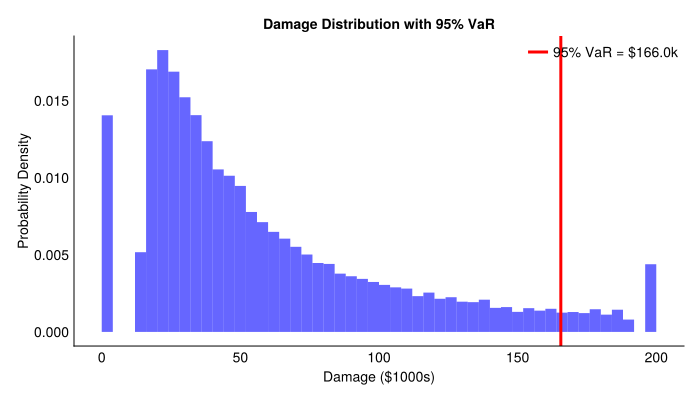
Value at Risk (VaR)

VaR at confidence level \(\alpha\): The \(\alpha\)-quantile of the loss distribution.

\[\text{VaR}_\alpha = F^{-1}_L(\alpha)\]

Example: 95% VaR

  • “5% of the time, losses exceed this value”
  • Also called: 20-year loss (same concept, different vocab)

In Julia:

VaR_95 = quantile(losses, 0.95)

VaR Illustrated

Code
# Generate damage samples (house at 3ft elevation, $200k value)
n = 25_000
house_elevation = 3.0
house_value = 200.0  # in $1000s
hazards = rand(GeneralizedExtremeValue(5.0, 2.0, 0.1), n)
damages = [depth_damage(h - house_elevation) * house_value for h in hazards]

VaR_95 = quantile(damages, 0.95)

fig = Figure(size=(700, 400))
ax = Axis(fig[1, 1], xlabel="Damage (\$1000s)", ylabel="Probability Density", title="Damage Distribution with 95% VaR")
hist!(ax, damages, bins=50, color=(:blue, 0.6), normalization=:pdf)
vlines!(ax, [VaR_95], color=:red, linewidth=3, label="95% VaR = \$$(round(VaR_95, digits=0))k")
axislegend(ax, position=:rt)
fig

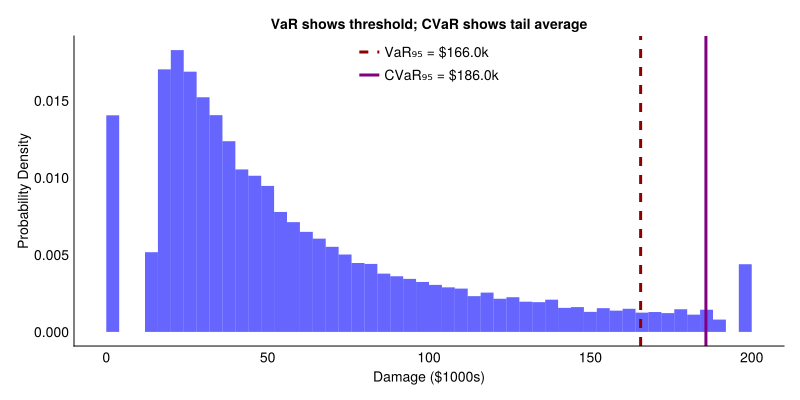
Conditional Value at Risk (CVaR)

CVaR (Expected Shortfall): Average loss in the worst \(\alpha\)% of cases.

\[\text{CVaR}_\alpha = E[L \mid L > \text{VaR}_\alpha]\]

In Julia:

VaR_95 = quantile(losses, 0.95)
CVaR_95 = mean(losses[losses .> VaR_95])

VaR vs. CVaR Illustrated

Code
# Compute VaR and CVaR
VaR_95 = quantile(damages, 0.95)
tail_losses = damages[damages.>=VaR_95]  # Use >= to ensure non-empty
CVaR_95 = mean(tail_losses)

fig = Figure(size=(800, 400))
ax = Axis(fig[1, 1], xlabel="Damage (\$1000s)", ylabel="Probability Density",
    title="VaR shows threshold; CVaR shows tail average")

# Main histogram
hist!(ax, damages, bins=50, color=(:blue, 0.6), normalization=:pdf)

# Add lines
vlines!(ax, [VaR_95], color=:darkred, linewidth=3, linestyle=:dash,
    label="VaR₉₅ = \$$(round(VaR_95, digits=0))k")
vlines!(ax, [CVaR_95], color=:purple, linewidth=3,
    label="CVaR₉₅ = \$$(round(CVaR_95, digits=0))k")

axislegend(ax, position=:ct, backgroundcolor=:white)
fig

Why CVaR > VaR

VaR tells you the threshold; CVaR tells you what happens beyond it.

  • VaR answers: “What loss do I exceed 5% of the time?”
  • CVaR answers: “When things go bad, how bad do they get on average?”
  • VaR says nothing about the severity of tail events

Example: If your 95% VaR is $100k, that just means 5% of outcomes are worse. But are they $101k worse or $1M worse? CVaR answers this.

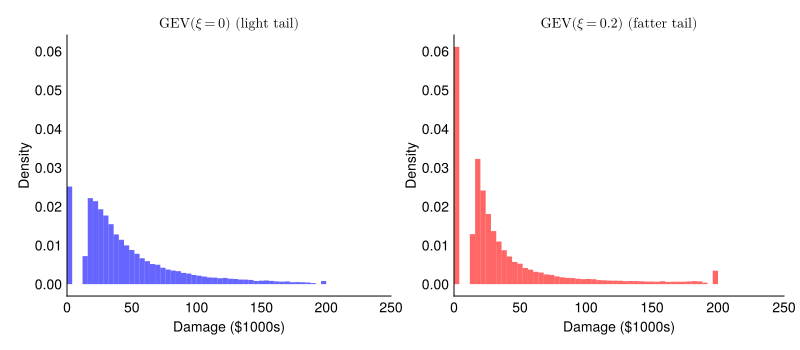
Worked Example: Same EAD, Different Tails

Code
# Two GEV distributions calibrated to produce similar EAD but different tails
# A: Gumbel (light tail) with higher location
# B: Fréchet (fat tail) with lower location to match mean
dist_A = GeneralizedExtremeValue(5.5, 1.8, 0.0)   # Gumbel (light tail)
dist_B = GeneralizedExtremeValue(4.5, 1.5, 0.25)   # Fréchet (fat tail)

n = 50000
house_elev = 4.0
house_val = 200.0  # $1000s
damages_A = [depth_damage(h - house_elev) * house_val for h in rand(dist_A, n)]
damages_B = [depth_damage(h - house_elev) * house_val for h in rand(dist_B, n)]

# Compute metrics (use >= to ensure non-empty tail samples)
VaR95_A = quantile(damages_A, 0.95)
VaR95_B = quantile(damages_B, 0.95)
metrics = (
    EAD_A=mean(damages_A),
    EAD_B=mean(damages_B),
    VaR95_A=VaR95_A,
    VaR95_B=VaR95_B,
    CVaR95_A=mean(damages_A[damages_A.>=VaR95_A]),
    CVaR95_B=mean(damages_B[damages_B.>=VaR95_B])
)

fig = Figure(size=(800, 350))
ax1 = Axis(fig[1, 1], xlabel="Damage (\$1000s)", ylabel="Density",
    title=L"GEV($\xi = 0$) (light tail)")
ax2 = Axis(fig[1, 2], xlabel="Damage (\$1000s)", ylabel="Density",
    title=L"GEV($\xi = 0.2$) (fatter tail)")

hist!(ax1, damages_A, bins=50, color=(:blue, 0.6), normalization=:pdf)
hist!(ax2, damages_B, bins=50, color=(:red, 0.6), normalization=:pdf)

xlims!(ax1, 0, 250)
xlims!(ax2, 0, 250)
linkyaxes!(ax1, ax2)

fig

Same EAD, Different Tail Risk

Metric Distribution A Distribution B
EAD $46.0k $36.0k
95% VaR $130.0k $137.0k
95% CVaR $158.0k $174.0k

Monte Carlo for Risk Metrics

Today

  1. Vocabulary: Extreme Value Statistics

  2. Fat Tails

  3. Risk Metrics

  4. Monte Carlo for Risk Metrics

  5. Wrap Up

The Monte Carlo Workflow

  1. Sample hazard scenarios from distribution
  2. Apply damage function to each scenario
  3. Summarize the damage samples

Once you have samples, any metric is trivial:

EAD = mean(damages)
VaR_95 = quantile(damages, 0.95)
CVaR_95 = mean(damages[damages .> VaR_95])

Computing All Metrics

Code
# Complete Monte Carlo workflow (same setup as Lab 2)
n_samples = 100_000

# 1. Sample hazards (GEV for storm surge, same as Lab 2)
surge_dist = GeneralizedExtremeValue(5.0, 2.0, 0.1)
hazards = rand(surge_dist, n_samples)

# 2. Apply damage function (house at 4ft elevation, $300k value)
base_elevation = 4.0
house_value = 300_000
damages = [depth_damage(h - base_elevation) * house_value for h in hazards]

# 3. Compute metrics
EAD = mean(damages)
VaR_95 = quantile(damages, 0.95)
VaR_99 = quantile(damages, 0.99)
CVaR_95 = mean(damages[damages.>=VaR_95])  # Use >= to ensure non-empty
CVaR_99 = mean(damages[damages.>=VaR_99])

println("Risk Metrics (house value = \$300k, base elevation = 4ft)")
println("━"^50)
println("Expected Annual Damage (EAD):     \$$(round(EAD, digits=0))")
println("95% VaR (20-year loss):           \$$(round(VaR_95, digits=0))")
println("99% VaR (100-year loss):          \$$(round(VaR_99, digits=0))")
println("95% CVaR (avg loss in worst 5%):  \$$(round(CVaR_95, digits=0))")
println("99% CVaR (avg loss in worst 1%):  \$$(round(CVaR_99, digits=0))")
Risk Metrics (house value = $300k, base elevation = 4ft)
━━━━━━━━━━━━━━━━━━━━━━━━━━━━━━━━━━━━━━━━━━━━━━━━━━
Expected Annual Damage (EAD):     $67216.0
95% VaR (20-year loss):           $223965.0
99% VaR (100-year loss):          $300000.0
95% CVaR (avg loss in worst 5%):  $264827.0
99% CVaR (avg loss in worst 1%):  $300000.0

Why Monte Carlo is Essential

For fat-tailed distributions:

  • Analytical formulas often don’t exist
  • Numerical integration struggles with heavy tails
  • Monte Carlo naturally captures rare events (with enough samples)

Key insight: Increase sample size when tails matter more.

Advanced Sampling (Preview)

Naive Monte Carlo requires many samples to capture rare events:

  • To get 10 samples of a 1-in-1000 event, you need ~10,000 runs

Advanced techniques can do better:

  • Importance sampling: Oversample the tail, then reweight
  • Stratified sampling: Ensure coverage across the distribution

These are beyond our scope, but good to know they exist when you need them.

Wrap Up

Today

  1. Vocabulary: Extreme Value Statistics

  2. Fat Tails

  3. Risk Metrics

  4. Monte Carlo for Risk Metrics

  5. Wrap Up

Key Takeaways

  1. Return period and return level are inverse operations on the CDF
  2. Fat tails mean extremes dominate
  3. We can measure fat tails using \(\alpha\) or \(\xi\)
  4. EAD averages over everything; VaR gives a threshold; CVaR captures the tail
  5. Monte Carlo lets us compute metrics from samples

References

Doss-Gollin, J., Farnham, D. J., Lall, U., & Modi, V. (2021). How unprecedented was the February 2021 texas cold snap? Environmental Research Letters, 16(6), 064056. https://doi.org/10.1088/1748-9326/ac0278
Jones, D. (2025). The uninsurable future: The climate threat to property insurance, and how to stop it. Yale Law Journal, 135. Retrieved from https://yalelawjournal.org/essay/the-uninsurable-future-the-climate-threat-to-property-insurance-and-how-to-stop-it