Trade-offs & Values
Lecture (Remote)
Wednesday, March 11, 2026
Subjectivity in Decision-Making
Today
Subjectivity in Decision-Making
Multiple Objectives
Equity
Logistics
Recall: Module 2
In Weeks 5–8, we built a rigorous decision framework:
- Model uncertainty explicitly: \(\mathbf{s}\) is a distribution, not a point estimate
- Propagate uncertainty through costs and benefits
- Analyze sensitivity: which uncertainties drive the outcome?
- Ask: is more information worth getting? (VOI)
- Choose \(a^* = \arg\max_a \; \mathbb{E}[\text{NPV}(a, \mathbf{s})]\)
BCA Key Assumptions
Every BCA embeds value judgments:
- Everything can be converted to a common unit (usually dollars)
- The “right” trade-off between present and future is captured by the discount rate
- Expectations are sufficient (any risk aversion goes in the utility function)
Taboo Trade-Offs
Some conversions feel morally unacceptable (Daw et al., 2015):
- “How many species extinctions are worth $X billion in economic growth?”
- “How many additional flood deaths are acceptable to save $Y in infrastructure costs?”
- “Is it okay to displace a community if the aggregate NPV is positive?”
These are taboo trade-offs — converting them to dollars feels wrong, even if the math works.
Values in Decision-Making
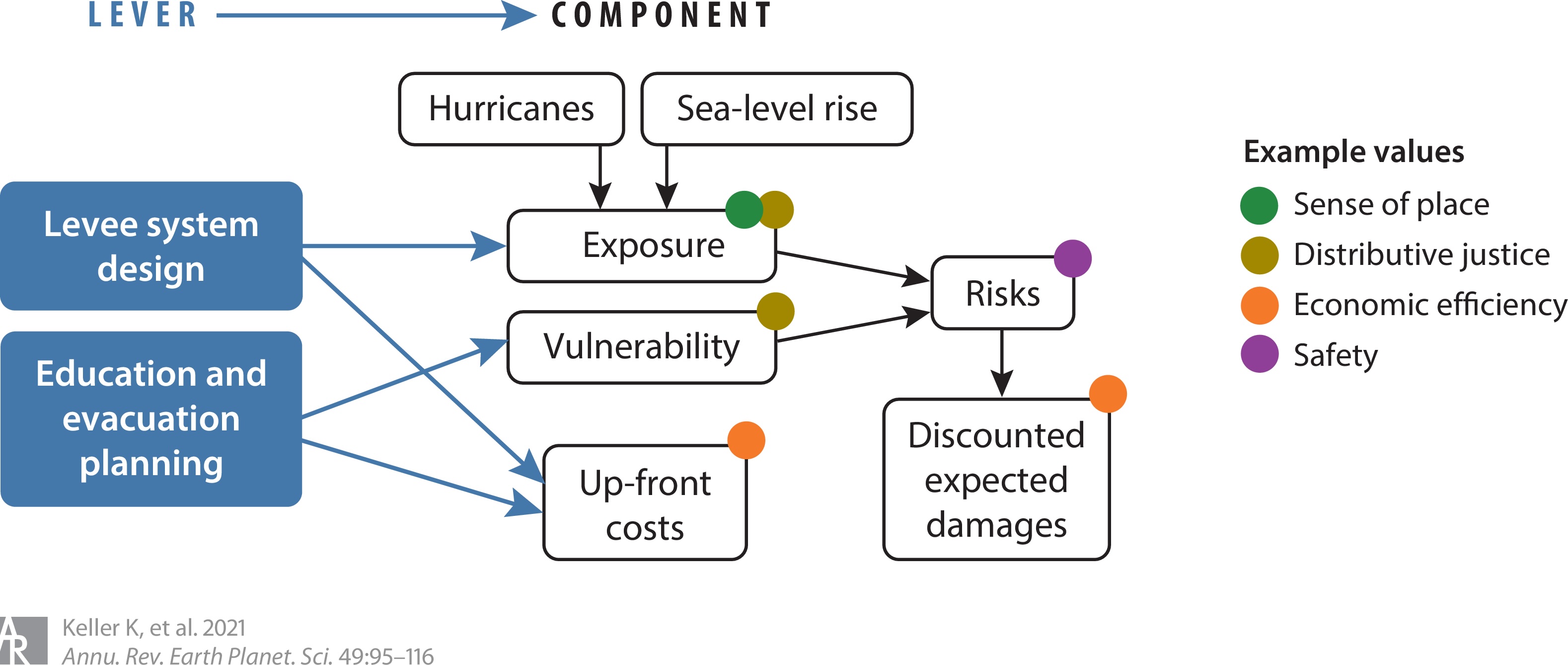
Keller et al. (2021)
Multiple Objectives
Today
Subjectivity in Decision-Making
Multiple Objectives
Equity
Logistics
Case Study: Harris County Flood Resilience Trust
After Hurricane Harvey, Harris County passed a $2.5 billion flood bond (2018). Limited Resilience Trust funds must be allocated across 200+ competing projects.
The question: which projects get funded?
- Pure BCR? Favors neighborhoods with the most property value
- HCFCD instead built a multi-criteria weighted scoring system (Harris County Flood Control District, 2022)
- Each project scored 0–10 on seven criteria, combined with explicit weights
What’s Hard to Compare?
Chat question: Give an example for
- coastal adaptation in Galveston
- a case study of interest to you
where two important things are genuinely hard to compare as apples to apples.
Multiple Objectives in Practice
HCFCD’s 2022 framework scores each project on seven criteria (Harris County Flood Control District, 2022):
- Cost per structure benefited in a 100-year event (30%)
- Cost per person benefited in a 100-year event (15%)
- Existing conditions: how severely does the area currently flood? (20%)
- Social Vulnerability Index of the affected community (20%)
- Long-term maintenance costs (5%)
- Environmental impacts (5%)
- Potential for multiple benefits — recreation, ecology (5%)
These may conflict, leading to trade-offs.
Three Approaches
Weighted sum: Collapse into one number \[w_1 \cdot \text{cost} + w_2 \cdot \text{risk} + w_3 \cdot \text{equity}\] Simple, but hides the trade-offs.
Satisficing / constraints: Set minimum thresholds (“\(BCR \geq 1\)”) and optimize remaining objectives. Avoids explicit weighting but requires choosing thresholds.
Pareto analysis: Find solutions where no objective can improve without worsening another. Reveals trade-offs without choosing weights. (We’ll formalize this in Week 12.)
Equity
Today
Subjectivity in Decision-Making
Multiple Objectives
Equity
Logistics
Equity as a Case Study
MCDA asks us to handle multiple competing objectives. What do we do when one of those objectives is “be fair”?
- Everyone agrees it matters
- But measuring it requires explicit value choices at every step
- Those choices are often hidden — which is exactly the problem this lecture is about
Equity in Climate Risk
Chat question: Where have you heard people talking about equity in climate risk or infrastructure?
- Which neighborhoods get buyouts after floods — and which don’t
- Who is consulted in flood protection planning
- Whether FEMA flood maps reflect cumulative environmental burdens
- Which communities receive green infrastructure investment
- Federal funding formulas for disaster recovery
Equity in Policy
How to account for equity is actively contested in law and policy:
Justice40 (Biden, 2021): 40% of benefits from certain federal climate investments must flow to disadvantaged communities — Equity operationalized via investment targeting; specifies outcome + characteristics, but leaves principle implicit
Executive Order 14173 (Trump, 2025): Prohibits federal agencies from using protected characteristics (race, sex) in decision-making — Restricts which characteristics axis options are legally available for federal programs
What Do We Mean by Equity?
Chat question: When you hear “equity” or “environmental justice,” what comes to mind?
Normative Frameworks
How should we evaluate whether a distribution is fair? Some key frameworks:
Worst-first (Rawlsian maximin): prioritize the least well-off — The same principle as the maximin rule from your exam, now applied to people
Maximize aggregate welfare (utilitarian): best average outcome — This is what standard BCA does
Restore past wrongs (reparative / corrective justice): address historical injustice — Redlining, discriminatory flood insurance, and underinvestment shaped today’s disparities
Equal treatment (egalitarian): same outcomes or resources for everyone
Sufficiency (sufficientarian): everyone gets “enough” — a minimum threshold
Maximin, Revisited
On the exam, you applied maximin to uncertain scenarios:
\[a^* = \arg\max_a \min_s \; U(a, s)\]
Choose the action whose worst-case outcome is best.
The Rawlsian framework applies the same logic to people:
\[\text{choose the policy that most benefits the least well-off person}\]
Same structure — “worst case” is now the worst-off individual.
Measuring Equity: A Taxonomy
Before we can measure equity, we must answer four questions (Pollack et al., 2024):
| Axis | Question | Options |
|---|---|---|
| Outcome | Equity in what? | Exposure, risk, funding, benefits, recovery |
| Scale | At what level? | Individual, neighborhood, city, region |
| Characteristics | Across whom? | Income, race, environmental burden, history |
| Principle | Why is that unfair? | Worst-first, utilitarian, reparative, egalitarian, sufficientarian |
Why the Taxonomy Matters
The same program can look equitable or inequitable depending on which axes you choose:
- Equal funding per household may still leave the poorest with the highest residual risk
- City-level exposure looks equitable; neighborhood-level reveals disparities
- Utilitarian benefits may favor wealthy areas (more property value to protect)
Policy A: protect densest district
- Utilitarian: ✓ higher aggregate benefit
- Worst-first: ✗ skips the poorest
Policy B: protect poorest district
- Utilitarian: ✗ lower aggregate benefit
- Worst-first: ✓ helps the least well-off
Funding Rules and Equity
Pollack et al. (2025) studied how federal funding allocation rules affect equity:
- Rules that maximize aggregate benefit-cost ratio tend to direct funding to wealthy areas (more property value to protect)
- Rules that prioritize social vulnerability scores direct funding to disadvantaged communities
- The funding formula is a policy lever — it encodes a moral framework whether intended or not
HCFCD’s framework is a local example: cost-per-structure (30%) vs. SVI (20%) vs. cost-per-person (15%) (Harris County Flood Control District, 2022)
Procedural Equity
Equity is not only about outcomes — it’s also about process (Fletcher et al., 2022):
- Who gets to participate in planning decisions?
- Whose knowledge counts?
- Who has the power to set the agenda?
Simply inviting marginalized communities to meetings is not enough if power dynamics remain unchanged.
Logistics
Today
Subjectivity in Decision-Making
Multiple Objectives
Equity
Logistics
Exam 2
- Friday, in class, 50 minutes
- Closed book
- Bring just a pencil
Module 3: Complementary Tools
These approaches work together — they are not alternatives:
- Robustness (Week 10): Does my recommended policy hold up across scenarios and across value frameworks?
- Scenario discovery (Week 11): What conditions or assumptions drive my conclusions?
- Multi-objective optimization (Week 12): Map the Pareto front — show decision-makers the trade-offs rather than collapsing to one number
- Sequential decision-making (Week 13): Make decisions over time as we learn what we value and how the system behaves
None of these resolve value questions — they make the choices visible and tractable.
Looking Ahead
- Wednesday: Paper discussion
- Friday: Exam 2 (covers Module 2)
- Next Monday (Week 10): Robustness and Deep Uncertainty — entering Module 3
References
James Doss-Gollin