Multi-Objective Optimization

Lecture

James Doss-Gollin

Monday, April 6, 2026

Draft: This content is under development.

The Problem with Weights

In Week 9, HCFCD evaluated flood control projects across 7 criteria using weighted scores.

Where do the weights come from?

  • Weights reflect values — whose values?
  • Different stakeholders have different priorities
  • Aggregation requires weights whether they are stated explicitly or embedded in a formula

From Single to Multiple Objectives

Today

  1. From Single to Multiple Objectives

  2. Dominance and Pareto Optimality

  3. Weighted Sum and Its Limits

  4. Multi-Objective Evolutionary Algorithms

  5. Reading and Using the Pareto Front

  6. When to Use Multi-Objective Framing

Single-Objective Optimization

Benefit-cost analysis frames adaptation as a single-objective problem:

\[a^* = \arg\max_a \; \mathbb{E}[\text{NPV}(a, \mathbf{s})]\]

This requires that all values can be monetized and aggregated.

Many adaptation objectives — equity, ecosystem health, cultural preservation — resist monetization.

Multiple Conflicting Objectives

A multi-objective problem has several objectives that cannot all be maximized simultaneously:

\[\max_a \; \{f_1(a),\; f_2(a),\; \ldots,\; f_k(a)\}\]

Coastal adaptation example:

  • \(f_1(a)\): minimize expected flood damages
  • \(f_2(a)\): minimize construction cost
  • \(f_3(a)\): maximize equity — benefits to vulnerable communities

Improving on \(f_1\) generally requires accepting worse \(f_2\). There is no single “best” solution.

Dominance and Pareto Optimality

Today

  1. From Single to Multiple Objectives

  2. Dominance and Pareto Optimality

  3. Weighted Sum and Its Limits

  4. Multi-Objective Evolutionary Algorithms

  5. Reading and Using the Pareto Front

  6. When to Use Multi-Objective Framing

What Does “Better” Mean?

With multiple objectives we need a new comparison rule.

Dominance: Solution \(a\) dominates solution \(b\) if:

  • \(a\) is at least as good as \(b\) on every objective
  • \(a\) is strictly better than \(b\) on at least one objective

If \(a\) dominates \(b\), there is no reason to choose \(b\) — you can do better.

Dominance: Example

Three house elevation strategies, two objectives (minimize both):

Strategy Expected Damages (\(M) | Construction Cost (\)M)
A: Elevate 1 ft 4.0 0.5
B: Elevate 3 ft 2.0 1.5
C: Elevate 5 ft 1.8 3.0
  • Does A dominate B? No — A is cheaper but has higher damages.
  • Does B dominate C? Yes — B is better on cost (1.5 < 3.0) and nearly as good on damages (2.0 vs 1.8)… wait, 2.0 > 1.8, so B is worse on damages. No — neither dominates.
  • The Pareto front is {A, B, C} — all three are non-dominated.

Dominance: Visualized

let
    points = [(2, 2), (1, 4), (4, 1), (3, 3), (5, 2)]
    labels = ["1", "2", "3", "4", "5"]
    colors = [:steelblue, :steelblue, :steelblue, :tomato, :steelblue]

    fig = Figure(; size=(500, 450))
    ax = Axis(
        fig[1, 1];
        xlabel=L"$f_1$ (maximize)",
        ylabel=L"$f_2$ (minimize)",
        xticksvisible=false,
        xticklabelsvisible=false,
        yticksvisible=false,
        yticklabelsvisible=false,
        limits=(0, 6, 0, 5.5),
    )
    for (i, (x, y)) in enumerate(points)
        scatter!(ax, [x], [y]; markersize=22, color=colors[i])
        text!(ax, x - 0.2, y + 0.25; text=labels[i], fontsize=18, font=:bold)
    end

    # Arrow from 1 to 4 showing dominance
    arrows!(ax, [2.15], [2.15], [0.65], [0.65]; linewidth=1.5, color=:gray50)
    text!(ax, 2.7, 2.85; text="dominates", fontsize=12, color=:gray50, rotation=π / 4)

    fig
end
Warning: `arrows` are deprecated in favor of `arrows2d` and `arrows3d`.
@ Makie ~/.julia/packages/Makie/kJl0u/src/basic_recipes/arrows.jl:166

Five candidate solutions. Point 4 (red) is dominated by point 1: worse on both objectives. Points 1, 2, 3, 5 are mutually non-dominated.

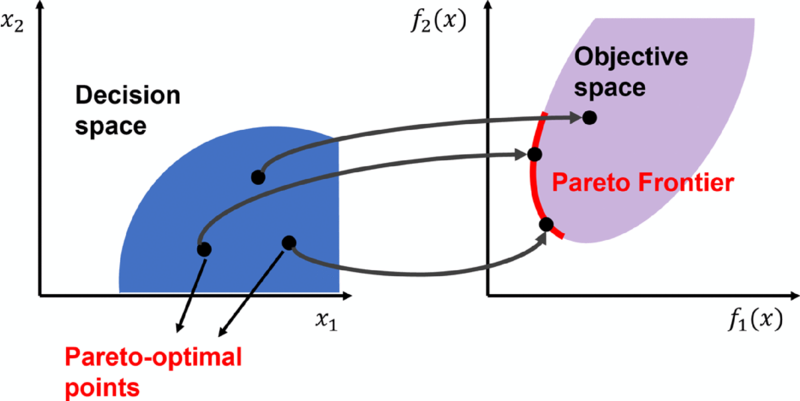
The Pareto Front

The Pareto front is the set of all non-dominated solutions.

  • No solution on the front can be improved on one objective without worsening another
  • Reveals trade-offs without requiring weights
  • The “efficient frontier” of feasible performance

. . .

The Pareto front identifies which solutions are worth considering. Choosing among them is a separate decision that requires values.

Figure 1: A Pareto front in two objectives. Source: Smith et al. (2022)

Weighted Sum and Its Limits

Today

  1. From Single to Multiple Objectives

  2. Dominance and Pareto Optimality

  3. Weighted Sum and Its Limits

  4. Multi-Objective Evolutionary Algorithms

  5. Reading and Using the Pareto Front

  6. When to Use Multi-Objective Framing

Can Weighted Sum Find the Pareto Front?

We can scalarize the problem:

\[\min F(a) = \sum_i w_i f_i(a)\]

Sweeping weights \(w_i\) can recover parts of the Pareto front — but not all of it.

  • Weighted sum only finds solutions on the convex hull of the front
  • Non-convex regions (common in engineering problems) are unreachable by any weighting
  • You can miss important solutions entirely

Convex vs. Non-Convex Fronts

Convex: weighted sum works

Non-convex: weighted sum misses the red region
Figure 2: From Sudhoff, “Engineering Analysis and Design Using Genetic Algorithms,” Purdue.

Multi-Objective Evolutionary Algorithms

Today

  1. From Single to Multiple Objectives

  2. Dominance and Pareto Optimality

  3. Weighted Sum and Its Limits

  4. Multi-Objective Evolutionary Algorithms

  5. Reading and Using the Pareto Front

  6. When to Use Multi-Objective Framing

How MOEAs Work

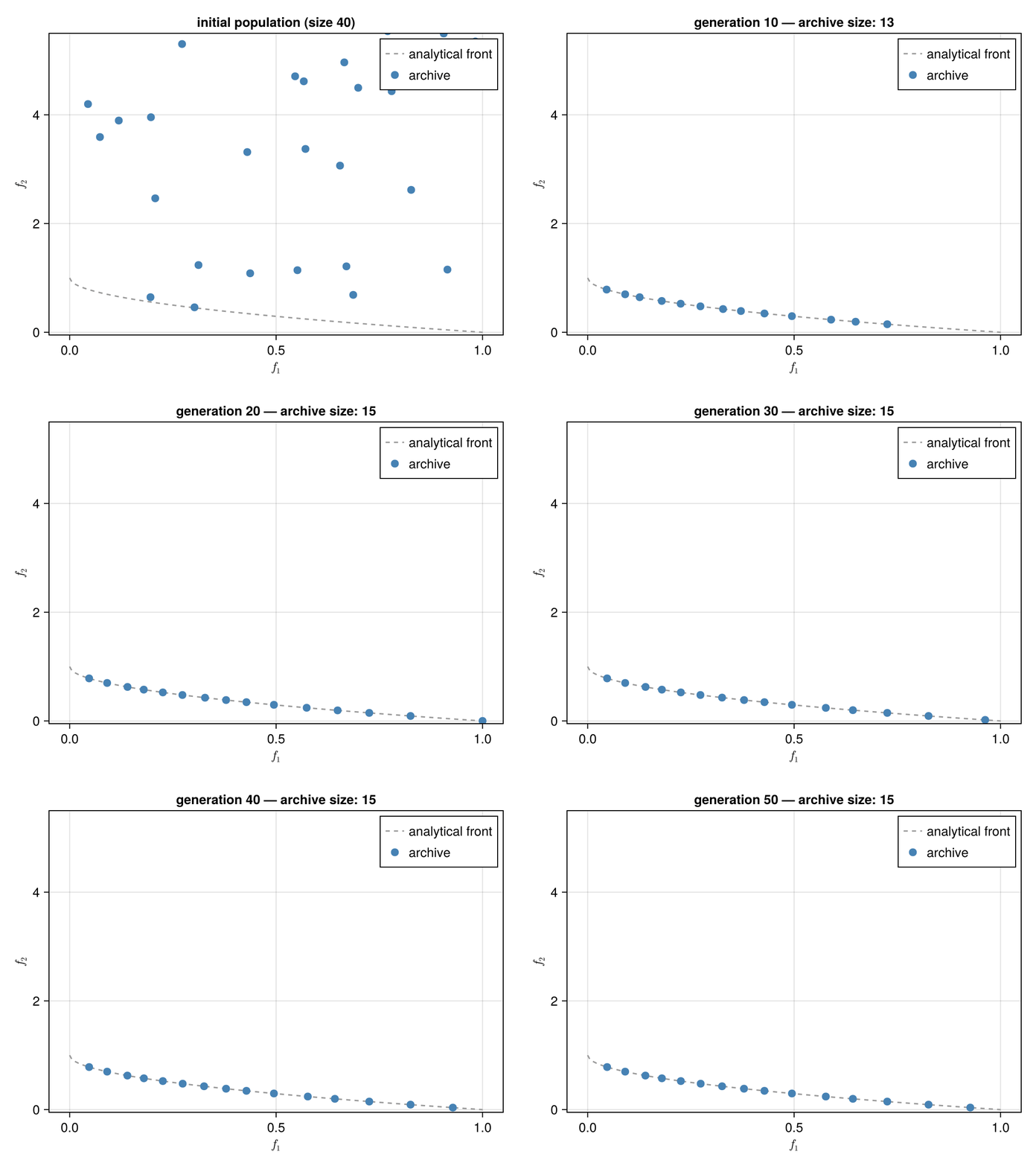
Multi-objective evolutionary algorithms (MOEAs) search for an approximation of the full Pareto front simultaneously.

Core ideas:

  • Maintain a population of candidate solutions that evolves over generations
  • Selection favors non-dominated solutions (dominance-based ranking)
  • Diversity preservation spreads solutions across the front — not just one cluster
  • Repeat until convergence

Result: a set of solutions approximating the full trade-off curve — including non-convex regions.

Common MOEAs in Climate/Water Work

  • NSGA-II: Classic; uses crowding distance for diversity
  • Borg: Widely used in water resources; adaptive population, epsilon-dominance archiving
  • Both widely used; Borg tends to perform better on complex, many-objective problems

Convergence diagnostics:

  • Repeat with different random seeds — do results change significantly?
  • Hypervolume indicator: measures how much of the objective space the front covers
  • Compare to weighted-sum benchmarks to detect missed regions

What Does Many-Objective Look Like?

With 2 objectives: a curve.

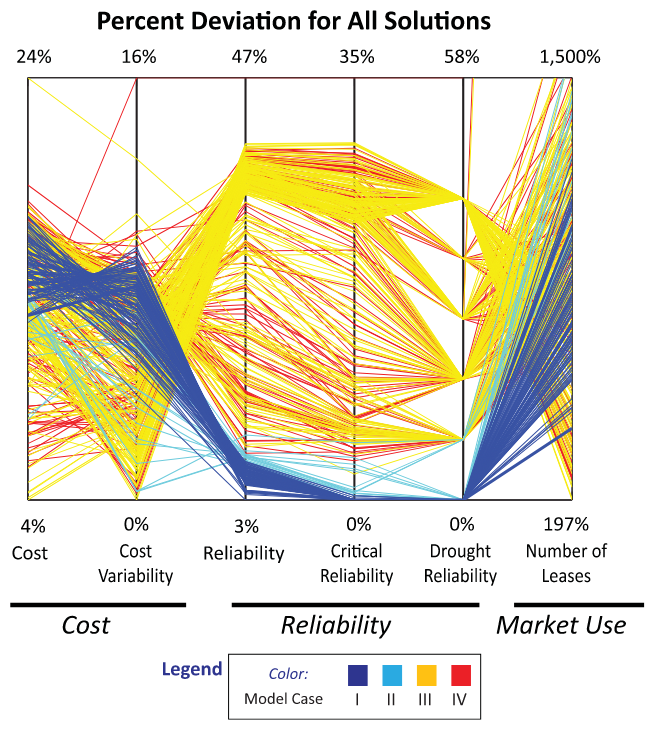
With 3+ objectives: a surface — impossible to visualize directly.

Parallel axis plots show all objectives simultaneously.

Each line = one non-dominated solution.

Figure 3: Parallel axis plot of non-dominated solutions across six objectives. Source: Kasprzyk et al. (2013)

Reading and Using the Pareto Front

Today

  1. From Single to Multiple Objectives

  2. Dominance and Pareto Optimality

  3. Weighted Sum and Its Limits

  4. Multi-Objective Evolutionary Algorithms

  5. Reading and Using the Pareto Front

  6. When to Use Multi-Objective Framing

Reading a Pareto Front

On a Pareto front plot, each axis is one objective and each point is a non-dominated solution.

The “knee” of the front:

  • Region of high curvature — large gains on one objective for small losses on another
  • Often a practical default if no strong preference exists
  • Not always present; depends on problem structure

The analyst generates the front; the decision-maker selects a solution from it.

How Many Objectives?

More objectives → richer problem representation, but real costs:

  • Computational: exponentially more solutions needed to cover the front
  • Conceptual: harder to reason about trade-offs in high dimensions
  • Communication: harder to show decision-makers and stakeholders

Rule of thumb: use as few objectives as possible. Combining objectives into a scalar is often a good idea — when the assumptions hold.

When to Use Multi-Objective Framing

Today

  1. From Single to Multiple Objectives

  2. Dominance and Pareto Optimality

  3. Weighted Sum and Its Limits

  4. Multi-Objective Evolutionary Algorithms

  5. Reading and Using the Pareto Front

  6. When to Use Multi-Objective Framing

Choosing the Right Tool

Use multi-objective framing when:

  • Stakeholders genuinely disagree on how to weight objectives
  • Objectives are incommensurable — not easily reduced to dollars
  • You want to make trade-offs explicit and visible to decision-makers

Stick with single-objective (BCA) when:

  • One objective clearly dominates
  • Stakeholders agree on how to aggregate
  • Speed and simplicity matter more than exploring trade-offs

Looking Ahead

This week:

  • Wednesday: Madison leads discussion of Yang et al. (2023) — come prepared to discuss objectives, algorithm choice, and how results inform decisions
  • Friday: Lab 10 — generate and visualize Pareto fronts for the house elevation problem
  • Friday: Memo 2 due (Evidence & Robustness)

Week 13 (Monday): Putting it all together — how robustness, scenario discovery, sequential decisions, and multi-objective optimization connect in real projects.

References

Kasprzyk, J. R., Nataraj, S., Reed, P. M., & Lempert, R. J. (2013). Many objective robust decision making for complex environmental systems undergoing change. Environmental Modelling & Software, 42, 55–71. https://doi.org/10.1016/j.envsoft.2012.12.007
Smith, S., Southerby, M., Setiniyaz, S., Apsimon, R., & Burt, G. (2022). Multiobjective optimization and Pareto front visualization techniques applied to normal conducting rf accelerating structures. Physical Review Accelerators and Beams, 25(6), 062002. https://doi.org/10.1103/PhysRevAccelBeams.25.062002
Yang, S., Ruangpan, L., Torres, A. S., & Vojinovic, Z. (2023). Multi-objective Optimisation Framework for Assessment of Trade-Offs between Benefits and Co-benefits of Nature-based Solutions. Water Resources Management, 37(6–7), 2325–2345. https://doi.org/10.1007/s11269-023-03470-8